


Ripley the Casemaker: Digital Advocacy Platform for WICANYS
OverviewRolesCollaboratorsBACKGROUND
WIC agencies and participants hold deep, community-rooted knowledge about program needs, yet consistently struggle to translate that knowledge into legislative impact. Advocates face a resource gap: they lack the time and political strategy to craft data-backed arguments tailored to specific lawmakers, while lobbyists working on their behalf have no centralized system to convert community insights into compelling, legislator-specific messaging. This disconnect leaves WIC chronically underrepresented at the legislative level, even as its community value remains clear.
Project Manager and UX Researcher
Elsa Jerry, Adrian Shin, Emmeline Pujiaji, Sapna Parihar (the best team ever)
OUTCOME
I conducted end-to-end stakeholder research — engaging WIC agency staff, participants, and lobbyists — and translated those findings into an AI-powered proof of concept advocacy platform. The solution combined a data collection survey, public-facing website, and an intelligent dashboard that helps lobbyists generate legislator-specific talking points and pitch materials grounded in community insights. I managed the client relationship from end to end, serving as the primary point of contact for WICANYS throughout the project lifecycle. I also developed a phased rollout plan to bring the solution to life sustainably
TimelineJanuary 2025 - July 2025


InsightsPROPOSING A NEW WAY TO ADVOCATE
As a researcher and strategist on this project, my main task was to understand the advocacy landscape for the WIC Association of New York State and identify opportunities to strengthen how WIC advocates make their case to legislators. But as I dug deeper into the problem space, I realized the challenge wasn't just about collecting more stories. Instead, it was about building an entirely new system for how those stories move through a network and land in the right hands at the right time.
UNDERSTANDING THEIR NEEDS
Through research, I identified four needs that cut across every stakeholder group and became the foundation for our design decisions:
Privacy and transparency are inseparable - People would only share their stories if they understood exactly how their data would be used and what impact it would create.
Humanized data is more persuasive. Pairing statistics with context — county, family size, age range — gave data emotional weight that raw numbers alone couldn't carry.
DEVELOPING EMPATHY WITH THE WIC NETWORK
To understand the full picture, we conducted research across 76 stakeholder touchpoints spanning WIC participants, agency staff, lobbyists, legislators, and advocates from analogous domains. Methods included attending the WICANYS conference to observe and interview staff and board members firsthand, conducting subject matter expert interviews with lobbyists and a sitting legislator, holding one-on-one interviews with participants and frontline staff, and running concept tests with analogous participants using Wizard-of-Oz and Think Aloud techniques.
Being in the room — at conference tables, over video calls, and in conversations with people who give everything to this program — gave me a grounded sense of what was actually missing and what a solution would need to earn people's trust.
AI should empower, not replace - Lobbyists needed full visibility and control. Any tool that filtered without explanation felt like it was hiding something
The ecosystem is the unit of design — no single touchpoint can be optimized in isolation — effective advocacy requires connecting every actor into one coherent system.
Building the SolutionThese insights directly shaped a three-part advocacy ecosystem our team designed and prototyped across parallel, iterative, and refinement phases.
WEBSITE REDESIGN
The first component was a restructured WICANYS website, rebuilt to serve multiple audiences at once. The homepage now offers clear pathways for participants looking to apply for WIC, advocates seeking resources, and member agencies looking for support — all from a single entry point. A dedicated Advocacy page gives visitors access to the latest policy updates and priority issues, while a Take Action page centralizes quick, low-effort actions like signing petitions and filling out the advocacy survey. The redesign also tightened the Membership page to clearly lay out benefits, requirements, and application steps. Every content decision was driven by one principle from our research: reduce friction, increase clarity. A complementary social media strategy was developed alongside the redesign to extend reach and drive engagement beyond existing stakeholders.
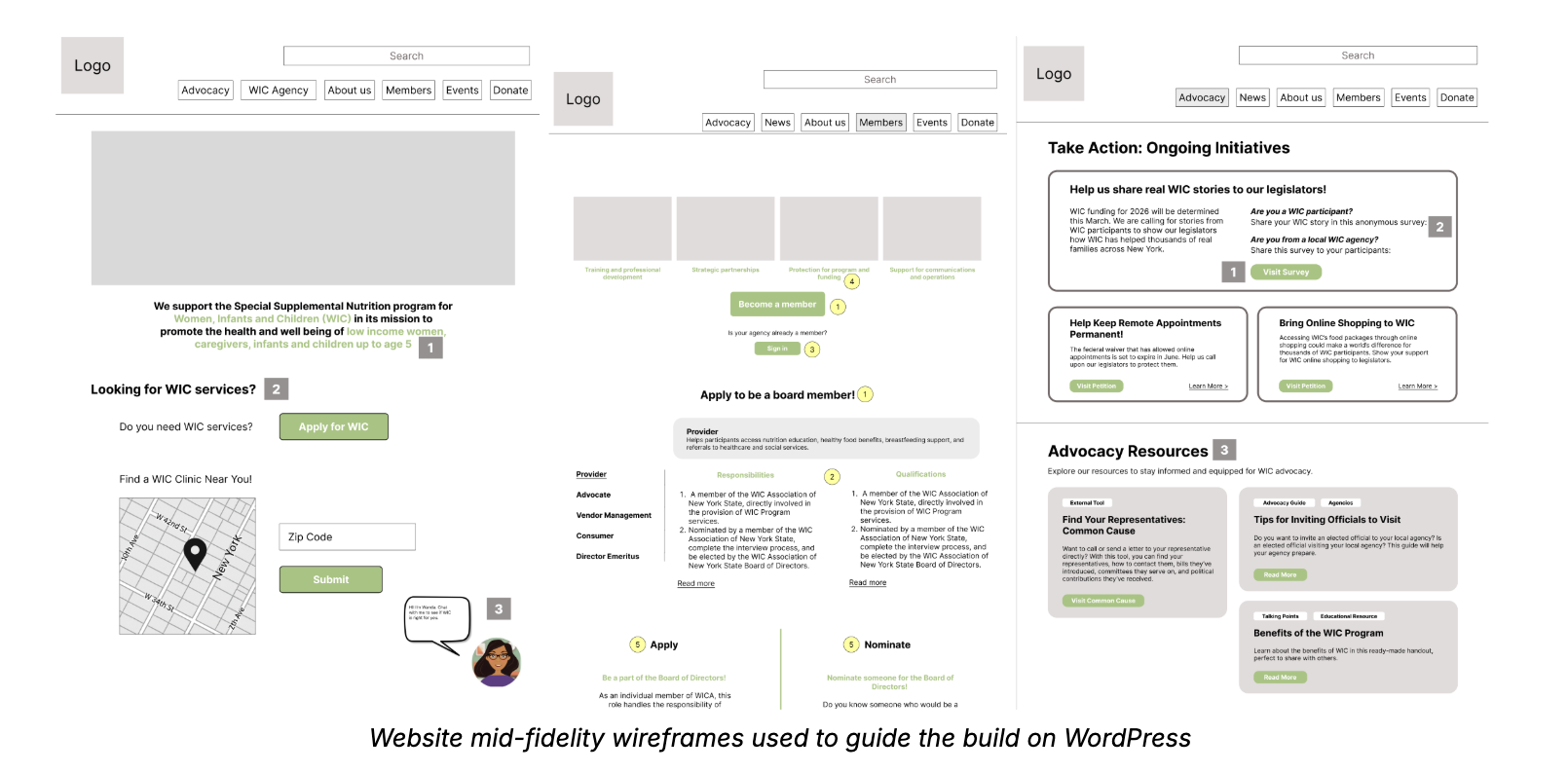
WICANYS CORE - The Dashboard
The second component was a functional advocacy dashboard built in Streamlit, designed around the real workflows of lobbyists and WIC advocates. At its core, the dashboard is a tool for turning raw community data into legislative arguments.
An access control page ensures that sensitive participant data stays protected — users must enter a code before the dashboard loads. Once inside, a sidebar of filters lets advocates slice the data by county, congressional district, age range, number of children, and caregiver type, making it easy to surface the stories most relevant to a specific legislator's district. Data visualizations throughout the dashboard are fully downloadable as images, ready to drop into reports, policy briefs, or presentations.
One of the features I was most invested in was the Generate Summary button — a prompt-engineered AI feature that produces quick, digestible insights from open-ended survey responses. This directly addressed what we heard from lobbyists: going through a massive spreadsheet of testimonials is time-intensive, and anything that could surface the signal faster was worth building. Alongside the summaries, a carousel of participant experiences lets advocates read raw responses grouped by topic, keeping the human voice intact and accessible.
RIPLEY, THE CASEMAKER
The third component was Ripley — a higher-fidelity AI-powered concept that pushed the vision further. Where WICANYS Core organized and surfaced data, Ripley was designed to be an intelligent, real-time collaborator that works alongside advocates from the first conversation to the final pitch.
At its core, Ripley is a retrieval-augmented AI system — meaning it doesn't just generate responses from a general model, but grounds every answer in real, specific data. It pulls simultaneously from survey responses, legislator profiles, bill sponsorship histories, voting records, and external advocacy datasets, synthesizing across all of them to surface connections a lobbyist might never find manually. Ask Ripley about a legislator and it won't just return a profile — it will identify which of that legislator's priority issues intersect with WIC's agenda and suggest which angles are most likely to resonate, tailored to that specific meeting.
As the advocate builds their case, Ripley's intelligence compounds. It populates talking points from curated data, flags the most relevant participant testimonials to support each argument, and generates pitch slide decks that visually map evidence to reasoning — all without requiring manual input from the user at every step. The AI is designed to do the heavy lifting of synthesis and pattern recognition, while always keeping the advocate in the driver's seat. Every AI-generated output is a suggestion, not a decision — the lobbyist reviews, adjusts, and approves before anything is locked in.
Ripley's data repository further extends its intelligence. Advocates can upload videos, link articles, or ask Ripley to find relevant external media, and the AI will scan and match that content to the talking points already in progress — surfacing quotes, statistics, or narratives that strengthen the case without requiring the user to read through everything themselves.
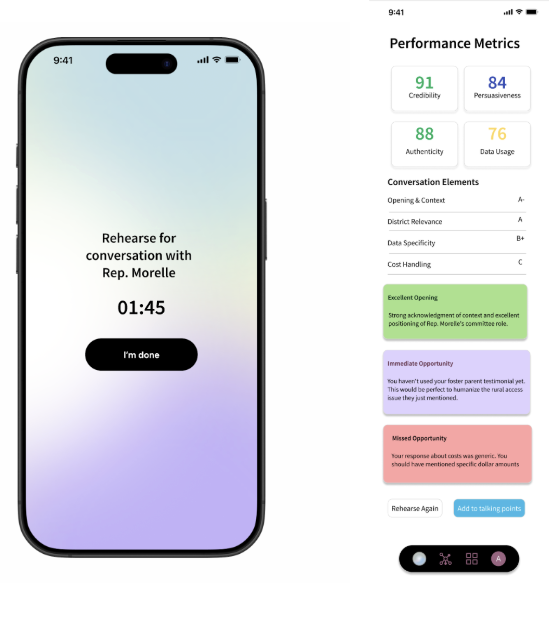
On mobile, Ripley's rehearsal feature brings AI coaching into the preparation process. Lobbyists practice their pitch out loud, with Ripley simulating the role of the legislator through adaptive, AI-supported conversation. After each rehearsal, Ripley scores the performance and delivers specific, actionable feedback — flagging weak arguments, suggesting stronger framings, and tracking improvement across practice rounds so advocates walk into the room genuinely prepared.
Example flow from end-to-end:
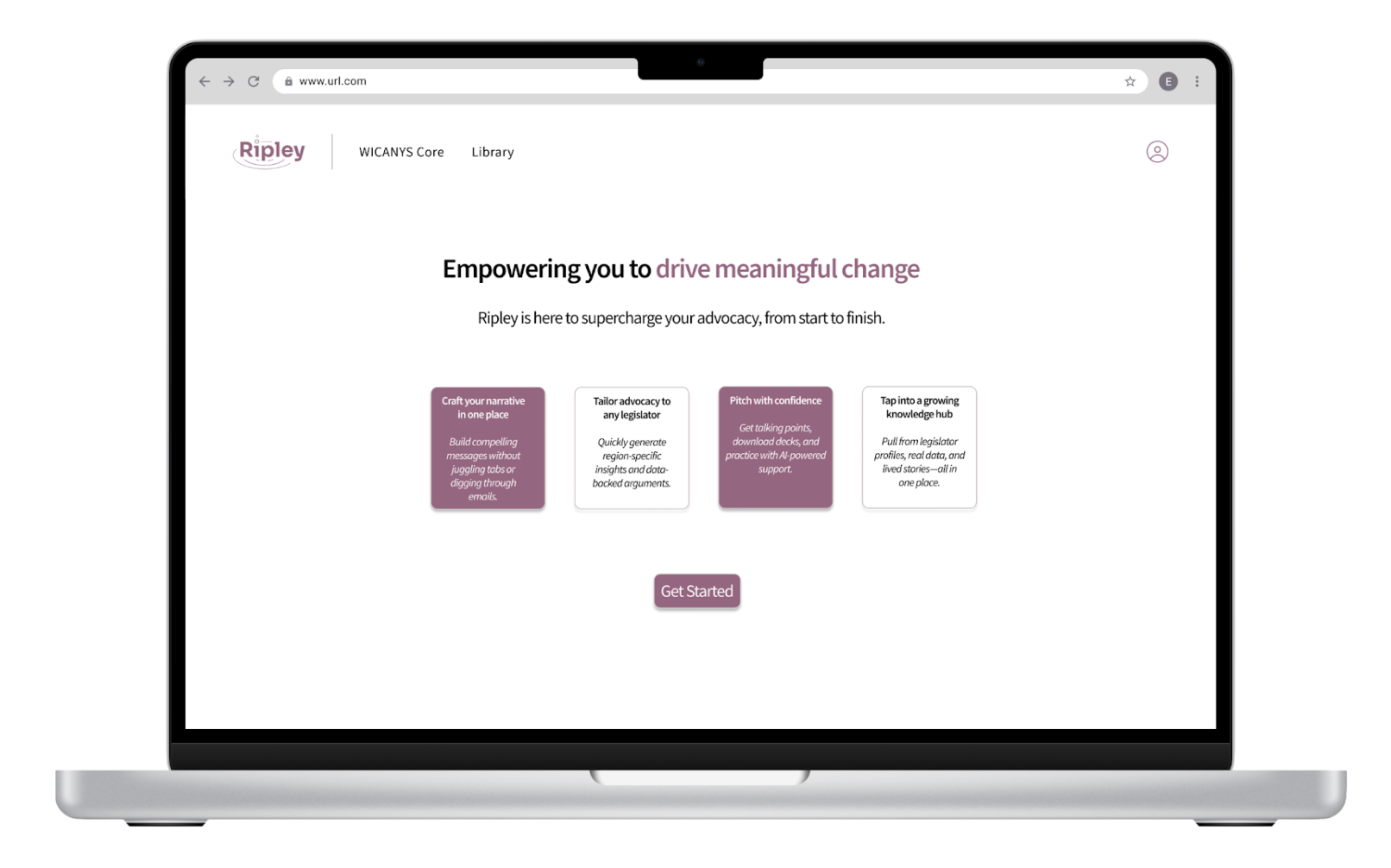
Ripley’s landing page, the first thing a user sees upon entering the solution. Clicking Get Started will bring them to a log in screen.
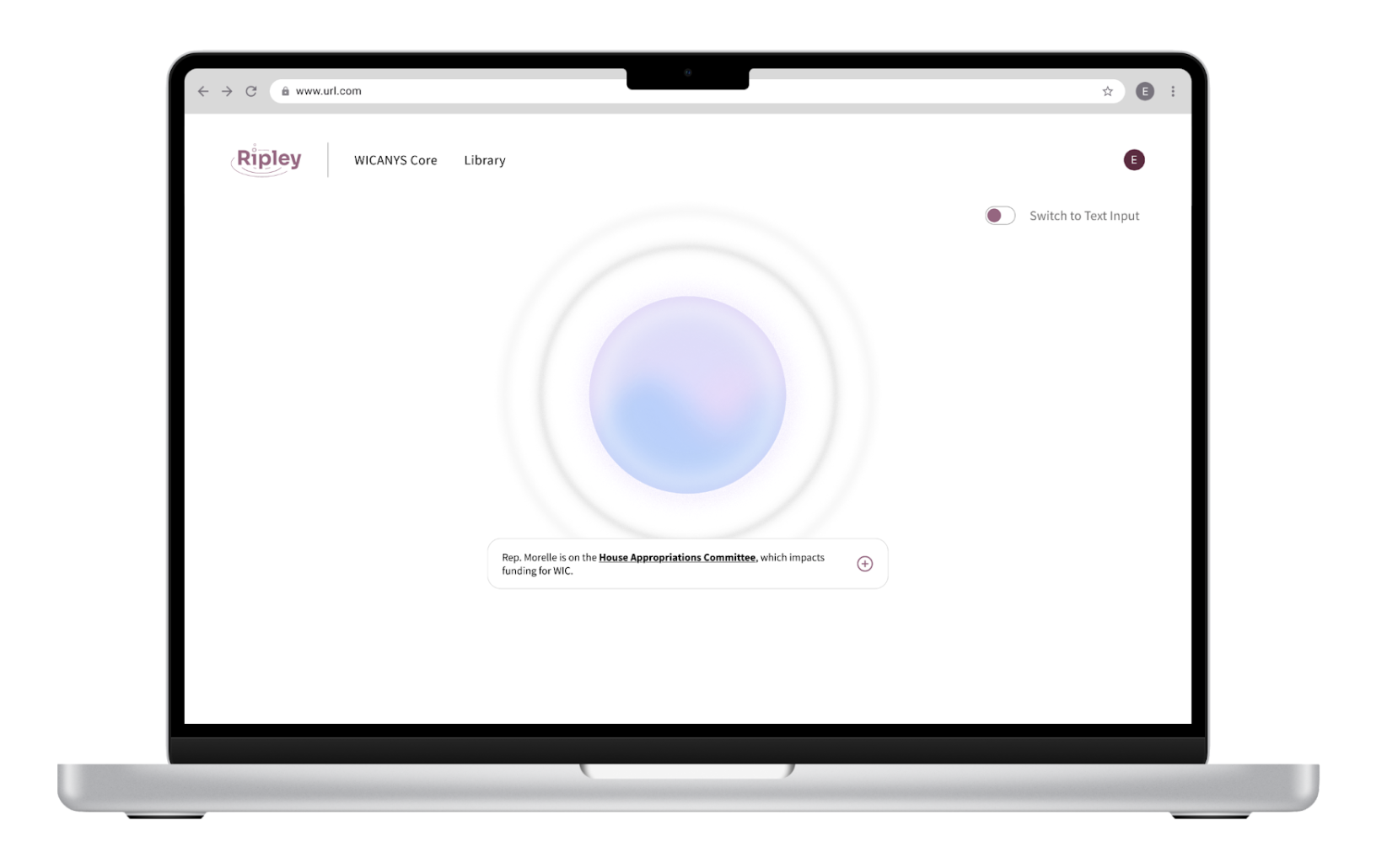
Ripley is represented on screen as an animated visual that shifts in color, size, and motion to signal its current state. Here, Ripley is actively responding to a user question — delivering its answer both aloud and as on-screen text so users can engage in whatever way works best for them.
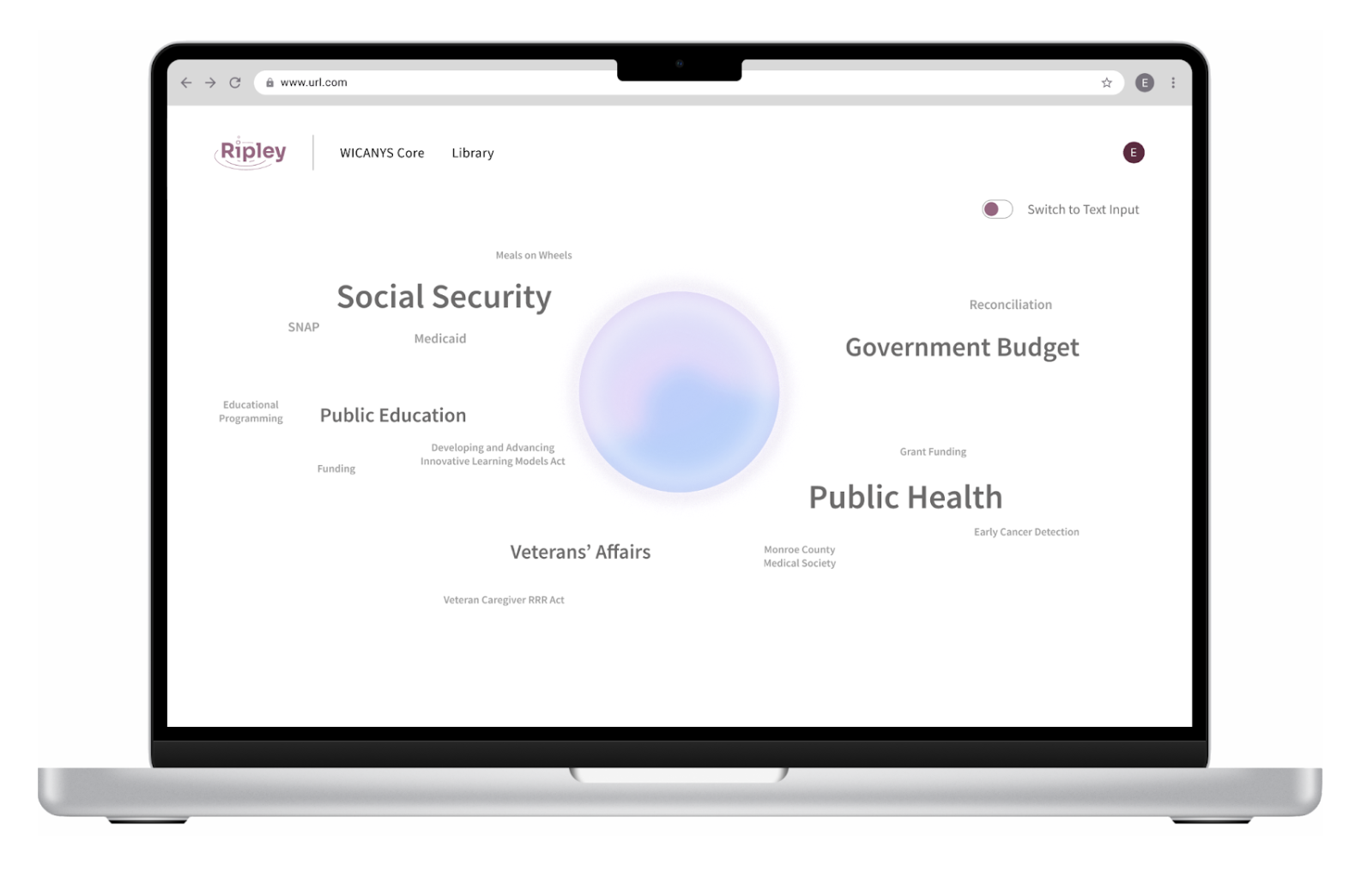
Ripley goes beyond surfacing isolated facts — it synthesizes data across sources to map a legislator's priority issues and activity, then connects those priorities directly to the advocate's agenda. Here, Ripley identifies which of a legislator's interests align with a specific bill, helping the advocate tailor their approach before walking into the room.
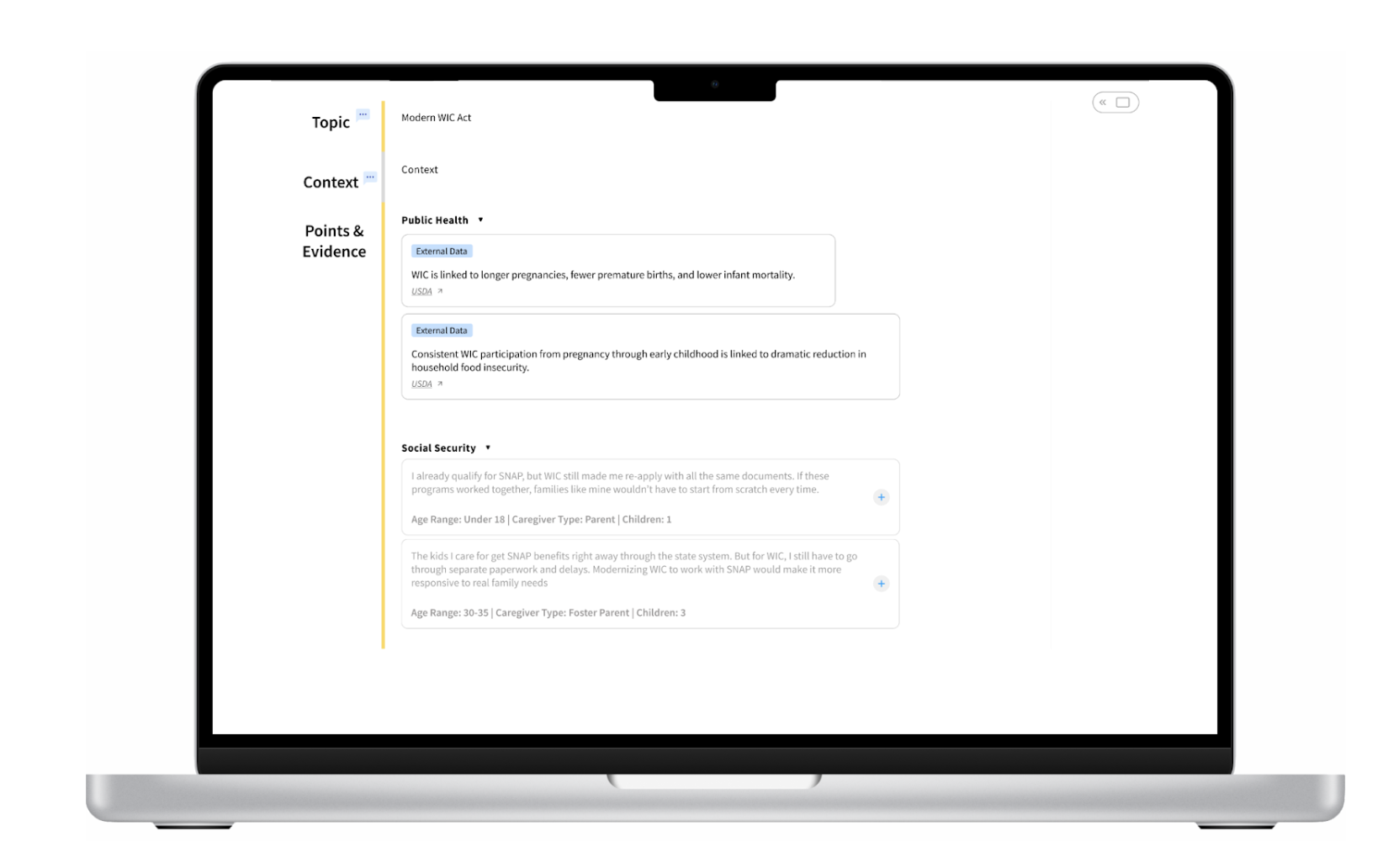
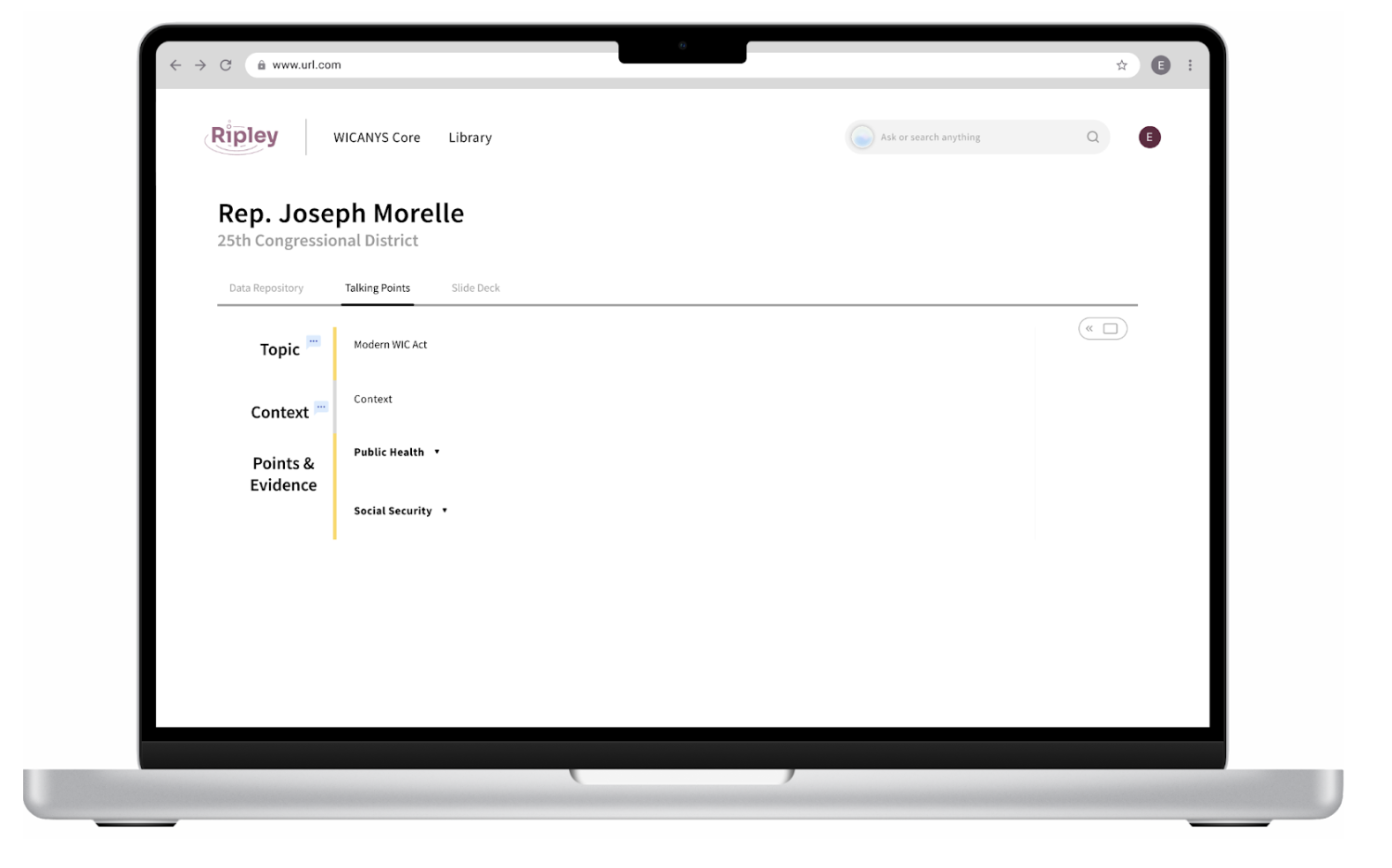
Once Ripley identifies the most resonant angles for a legislator, users can move into building out their talking points. Each board — a curated collection of data — has a dedicated tab where Ripley automatically populates key talking points from the previous conversation, no manual input required.
The conversation with Ripley continues as the user builds their case — here, asking Ripley to surface relevant facts and figures to support their arguments. Ripley displays the results on screen, but leaves the final call to the user on what gets saved to the board.
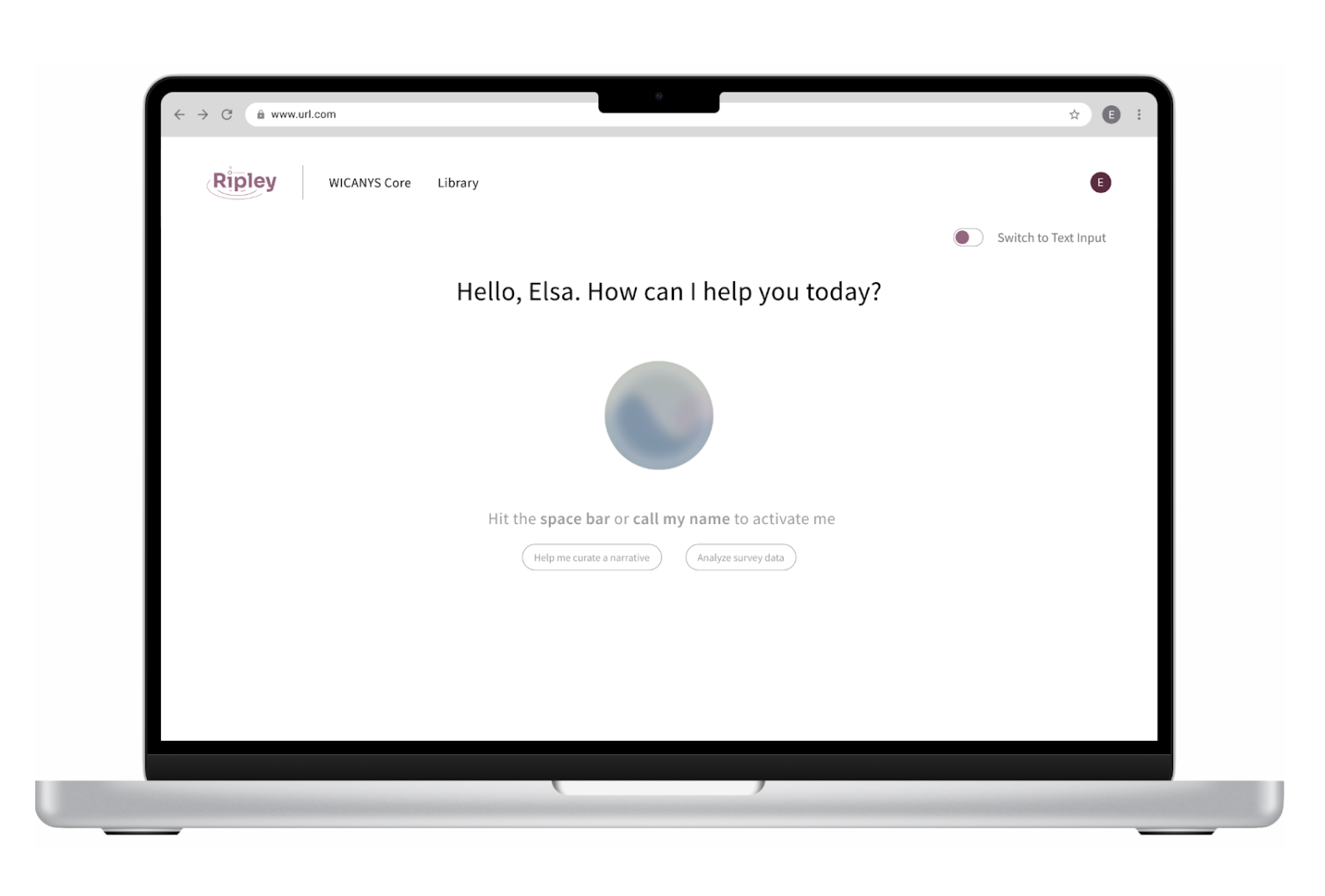
The main home screen a user lands on after logging in. The voice-activated AI is inactive by default, putting the user in control of when the conversation with Ripley begins.
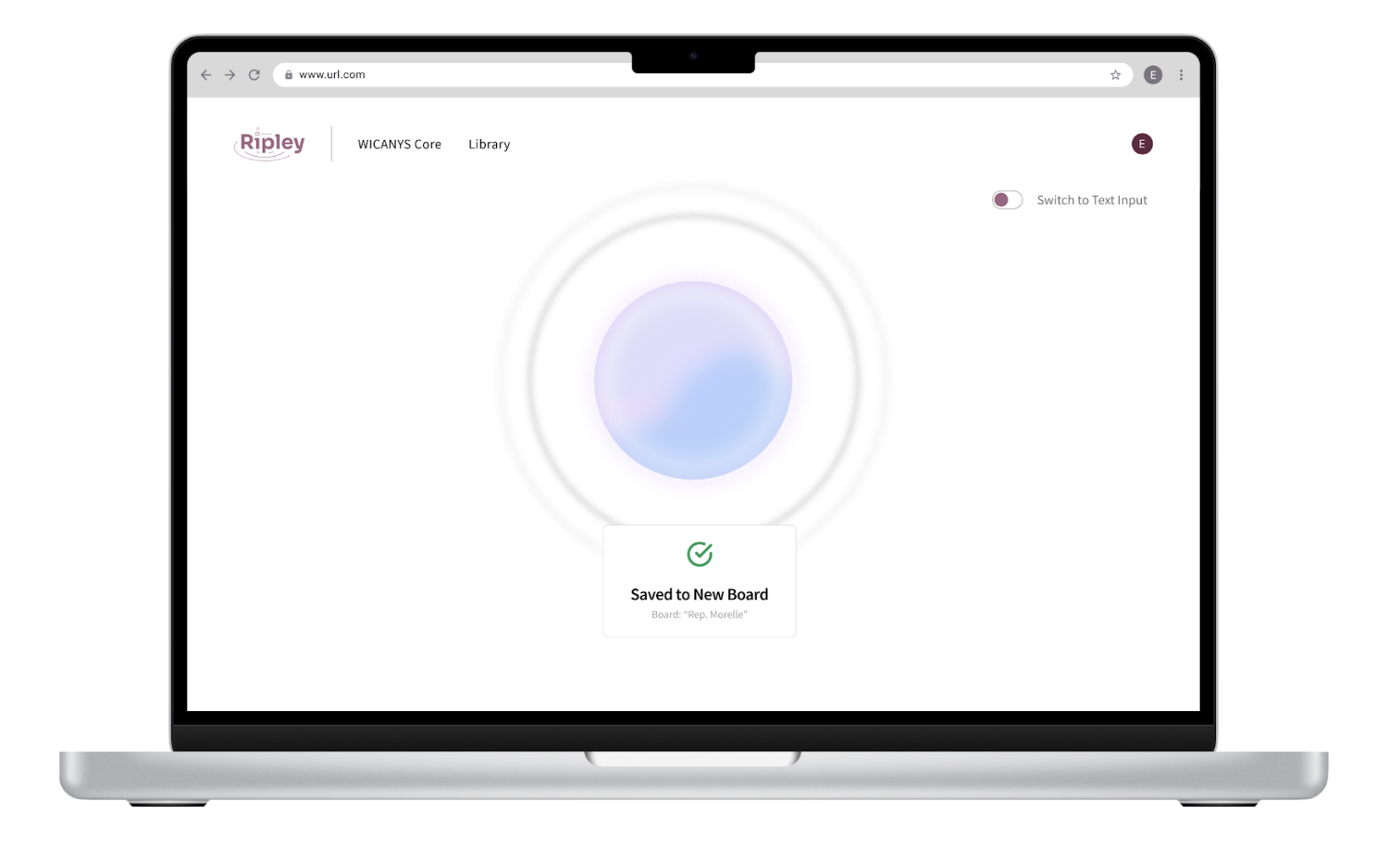
A core feature of Ripley is the ability to save and organize data on the fly. Users can store key statistics and responses from Ripley to build their own curated collection of evidence as they work.
Left: The rehearsal screen, where users can practice their pitch out loud with Ripley simulating the role of the legislator.
Right: After the rehearsal, Ripley delivers a performance breakdown with specific, actionable suggestions for improvement that can be folded directly back into the user's talking points — with the option to run through it again until they feel ready.
Major Contributions
+ Reflection
End-to-End Stakeholder Research
I contributed and sharpened my research skills across 76 touchpoints — spanning WIC participants, agency staff, lobbyists, legislators, and analogous advocates — and synthesized the findings into four insights that became the backbone of every design decision on the project.
AI Features and Risk Mitigation Strategy
I shaped Ripley's AI design direction and developed a responsible AI governance strategy covering the full pipeline — from consent flows and anonymization standards in data collection, to prompt documentation, human review requirements, bias spot-checks, and access controls for the dashboard.
This project challenged me to think beyond a single user or feature and design for an entire system. It was the first time I worked on a problem where the solution had to earn trust before it could create impact — and that shaped every decision we made, from how we worded a survey question to how Ripley surfaces data without taking control away from the lobbyist.
Managing the client relationship end-to-end also pushed me to grow in ways I didn't expect. Translating between research, design, and client expectations in real time taught me that clarity and communication are just as important as the work itself. And developing the rollout plan reminded me that a great idea without a viable path forward is just a prototype — grounding the vision in phases, costs, and real constraints is what makes it actionable.
If I had more time, I would have loved to actually build out the RAG pipeline that powers Ripley's core intelligence — getting hands-on with the retrieval architecture, the vector stores, and the data grounding that makes an AI system like this actually trustworthy and specific. Spoiler alert: I did get to do exactly that in my next program. You can see that work here.
WIC advocates are doing deeply meaningful work with very few resources. I left this project feeling a real sense of responsibility to make sure what we built was worth their time — and genuinely optimistic that the right tools, designed with the right values, can change how that work gets done.
Phased Rollout Plan I developed a three-phase rollout plan — from a single-region pilot with compensated community ambassadors, to a multi-site expansion, to a statewide rollout embedded in policy workflows — scoped at $40,000–$74,000 and built around open-source tools to stay financially sustainable for WICANYS.

APPENDIXRisk Mitigation Strategy - 7-page document